![[GRID]](http://www.nevermindthegrid.com/cdn/shop/files/grid-logo_ae9a103f-6f85-4572-9ac4-71ee718b7d1a.svg?v=1771083469&width=600)
The Universality of Laughter as a Mirror to Our Discomfort: In Conversation with Frank Willems
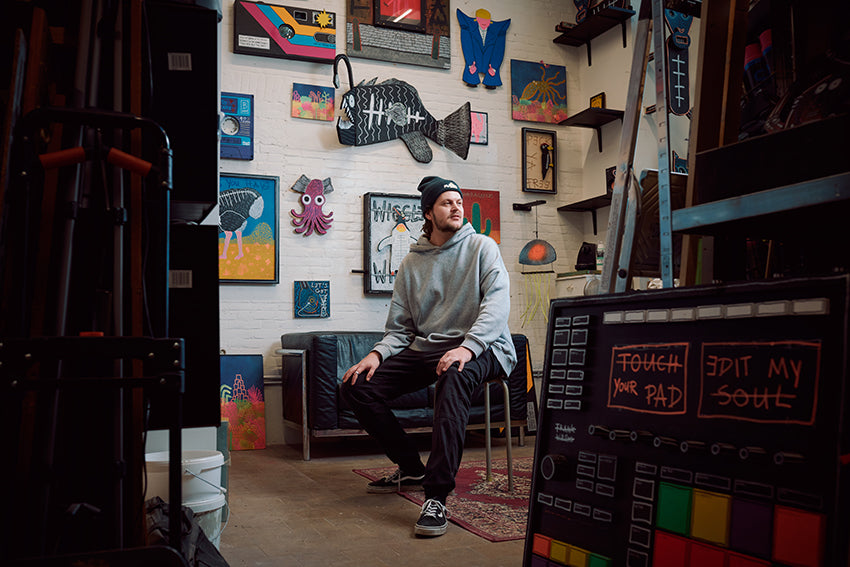
Anyone viewing the work of Frank Willems steps into a visual universe where playfulness and humor primarily take center stage. You are greeted by an abundance of bright neon colors and inviting, quirky objects. The often cheerful designs and interactive elements create a world where adults are allowed to be children again for a moment. But those who look longer will notice that Willems subtly holds up a mirror to the spectator at the same time. Behind the humor lies a sharp observer of the human psyche and the madness of our modern times.
The foundation for his artistry was laid about fourteen years ago during his shoe design studies in Sweden. The rather commercially oriented program was somewhat disappointing, but the visual arts course offered a welcome new source of inspiration and direction. Besides looking at art, he began experimenting and searching for his own visual language. Among others, he became fascinated by the artist Jean-Michel Basquiat, not just because of his raw style, but precisely because of the social urgency with which Basquiat spoke out against inequality.
This is a commitment that is also vital to Willems. Just like his source of inspiration, he frequently uses the motif of the skeleton. Not as a symbol of death, but rather as the ultimate proof of equality. Beneath our skin, after all, we - both humans and animals- are all built from that same structure of bones. Willems cherishes a deep desire to reach all layers of the population, young and old, with his work. Furthermore, he highly strives for connection—for a story in which everyone can recognize themselves, without having to exclude anyone else.
He also finds this open-mindedness in animals; for instance, he often uses the motif of the monkey in his work, which partly provides familiarity but can also be interpreted metaphorically. Animals do not wear social masks. They are on this earth to do what they do, though they are sometimes restricted or influenced by human intervention. By using them as characters, he can convey socially critical thoughts without alienating a specific group.
Yet, Willems’ work is anything but superficial entertainment. His ideas arise organically from fragments of everyday life: a newspaper article, a conversation overheard on the street, or remarkable behavior on social media. Among other things, the unquestioning belief in information found online and the blurring line between the real world and AI-generated images preoccupy him. The use of language in his work offers a way to reflect on this. For example, Willems engages the viewer by crossing out words, which sparks curiosity to decipher what is actually written. He also consistently reverses the letter 'E', inviting people to solve the visual puzzle. At the same time, it is a recurring and therefore recognizable element of his specific style.
Where the artist previously worked mainly in 2D on reclaimed scrap wood, he now increasingly seeks out interaction. His installations move, are meant to be touched, and often contain an element of surprise. For instance, the layered nature of his art sometimes becomes tangible through the use of blacklight effects. Under daylight, the viewer sees a certain image, but as soon as the UV light turns on, the work transforms, and a hidden, deeper layer lights up in neon colors. It is a striking metaphor for the human psyche, which likewise often hides more than what is shown on the outside. Willems does not shy away from giving human vulnerabilities, such as social discomfort or anxieties, a place in his work. While music- an indispensable backdrop to his creative process- plays non-stop, he succeeds in transforming the heaviness of life. Precisely by capturing the madness of the world in lightheartedness, he opens up a space in which we dare to look again, to feel, and above all: to laugh at ourselves a little.
Eline van der Haak
See works by Frank Willems at [GRID] Gallery, Stand 29, during Art The Hague.